* indicates the breed is not currently recognized in Canada
 *American Black Belly
A hair sheep, originally developed by crossbreeding primarily Mouflon and Barbados Blackbelly. The American Blackbelly is a breed of Corsican descent that is readily identifiable by a very well-defined coat pattern and is registered by the Barbados Blackbelly Sheep Association International- BBSAI. Rams generally display spectacular horns, while ewes may have horns or are polled (hornless). The American Blackbelly is a thrifty, energetic, small- to medium-sized sheep with a strong flocking instinct. Because of this trait, American Blackbelly sheep are excellent for training cutting horses and herding dogs. It is well adapted to a broad range of environments, breeding goals, and management styles. On the farm, it is desired for its productivity and thriftiness, great prolificacy, and fairly low maintenance. Because of their potential reproductive capacity and out-of-season breeding, ewes are suited to an accelerated lambing program. American Blackbelly sheep will grow more or less winter wool, mostly in response to local winter conditions, which is entirely shed in spring/summer. Blackbelly lamb is mild-flavored, lean meat
* indicates the breed is not currently recognized in Canada
 Bluefaced Leicester
A longwool sheep which was exported to Canada in the 1970s. Exported frozen semen from the United Kingdom is now used to expand the genetic diversity in Canada. This breed is raised primarily for meat, but their fleece is becoming from North East Englandincreasingly popular for handspinning. Bluefaced Leicester sheep may also have brown on their face. They have curly threadlike wool which makes it considerably lighter than others. These sheep have no wool on the head or neck. Bluefaced Leicesters are recognizable through their Roman noses, which have a dark blue skin which can be seen through the white hair, hence the name.
Mature Body Weight
Rams up to 110 kg
Ewes up to 89 kg
Fleece: Fine, dense, good lustre, long with a likeness to mohair
26 Micron and an average length of 85-90mm
 Border
Cheviot
Border
Cheviot
The Border Cheviot is a native of the Cheviot
Hills of Scotland and is said to have originated when Merino
sheep, carried by the ships of the Spanish Armada, washed ashore
and evolved with the local breeds. They have been raised in
Canada since the 1850s. Border Cheviots are extremely vigorous, hardy and good foragers
that can survive in harsher conditions than many other sheep.
They are a quick and alert breed, the ewes are excellent mothers
who need little help at lambing and the lambs grow quickly to
20 kg as milk lambs but progress slowly after that. Border Cheviot
rams are used as terminal sires to produce a fast rate of gain
in the Down breeds, and to give lambs smaller front ends and
heads for easier delivery in first time ewes.
Mature Body weight:
Rams: 70 - 85 Kg
Ewes: 55 - 70 Kg
Fleece: Long, strong and lustrous
 British Milk Sheep
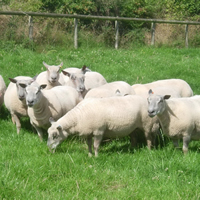
The breed was developed in England during the 1970's and released in 1980. The animals are medium to large in size, polled, with white, woolless, face and legs and have the ability to breed out of season. BMS are a prolific breed with yearling litter size avg. 2.21, 2-yr. olds at 2.63 and 3.07 in mature ewes. Lambing is usually reported as easy due to an exceptionally large pelvic area. A milk yield of 650-900L. has been reported during a 300 day lactation. The high milk yield results in even triplets often reaching 0.33kg./day in weight gain. Milk solids are quite high and protein content rises from about 5% in early lactation to about 7.5% in late lactation and fat content goes from 5.5 to 9%.
BMS produce a heavy, lean carcass
Rams: 103 kg
Ewes 79 kg
Fleece:
from 4.0kg./ewe to about 6.5kg./ram.
 Charollais
Charollais originated in France in the early
1800's from a cross of Leicester Longwool and local landrace
breeds. The breed is often used as a terminal sire to increase
the muscling and growth rate of the lambs. The Charollais has
excellent maternal qualities, early maturity, good fertility,
high prolificacity and are excellent milkers. They are a medium to large sheep, long, well muscled and have
a mature body weight of 100-150 kg for rams and 80-100kg for
ewes. The breed is found in more than twenty countries around
the world. The Charollais fleece is fine and dense.
 Clun
Forest
Clun
Forest
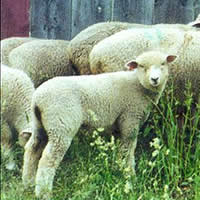
Clun Forest sheep are a local breed of the upland hill country between England and Wales. The first flock was imported into Nova Scotia, Canada in the 1970's. They are easy keepers, hardy and able to fend for themselves under harsh conditions, while still producing good lambs. For these reasons, the breed has spread into many pasture based systems across Canada and the US, where they thrive in the desert conditions of Utah, the humidity of British Columbia and the cold of Minnesota. Clun Forest sheep are a maternal breed. The ewes generally produce twins, are good mothers and good milkers. They are most often used in crossbreeding programs with Suffolk and Hampshire rams to produce market lambs. Clun Forest rams can be used on first time ewes to downsize the lambs and reduce lambing problems.
-Mature body weight
Rams 75-105 kg
Ewes 65-80 kg
Fleece:
Tight, fine texture. Free of kemp and dark or gray wool
 Corriedale
The Corriedale was developed in New Zealand during
the mid-19th century as breeders attempted to improve the meat
characteristics of the Merino sheep by cross-breeding with the
British longwool breeds, especially Lincoln. The Corriedale is now one of the most populous breeds throughout
the world with large flocks in Australia, New Zealand, South
America and the U.S. The Corriedale was imported to Canada from New Zealand, and
for many years was a popular dual purpose breed. The ewes are
average in prolificacy, good mothers and good milkers. The lambs
are slower-growing than the Down breeds but finish well as light
or heavy lambs. The popularity of the breed in Canada has declined
with the fortunes of the wool industry, but they remain an excellent
dual purpose choice for small acreage.
Body weight:
Rams: 80 - 125 Kg
Ewes: 60 - 80 Kg
Fleece: Bright, soft
 Cotswold
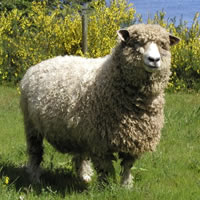
Cotswold sheep are a heritage breed in Canada. All Cotswold tend to be calm and friendly, known around the world as the "Gentle Giants". Cotswold sheep are polled (hornless) with black hooves. Their ability to maintain a good carcass size on less grain and produce an amazing fleece, makes the breed highly desirable for small farm flocks. They are also noted for having a very mild-flavoured meat. Today Cotswold are considered a fairly slow growing sheep, easily birthing hardy lambs that have small heads. Nicknamed the 'Golden Fleece Breed', Cotswold wool is exceedingly strong and lustrous. It hangs in long, ringlet locks, and attains 8 to 12 inches of growth in a year. One of the oldest breeds of sheep, it is unknown whether the Cotswold breed was named after the Cotswold Hills where they were found or alternatively, the hills were named after the Cotswold sheep that were already there. Body weight:
Rams: 115 - 130 Kg
Ewes: 80 - 100 Kg
Fleece: 20 to 30 cm (8 to 12 inches) in length, and weighing 6 to 9 Kg (13 to 20 lbs)
 *CVM/Romeldale Sheep
CVM/Romeldale sheep are a critically endangered fine-wool breed developed in California in the early 1900s from a cross of New Zealand Romney rams with Rambouillet ewes. The breeding program focused on producing soft, fine wool and good fleece weight as well as medium-to-large market lambs for meat. Romeldales were originally white, but in the 1960s, coloured lambs began to appear. A badger-faced variation sparked the interest of breeder Glen Eidman, who line-bred these "mutants" for several generations, further selecting for outstanding fleece quality. These sheep became known as "California Variegated Mutants", or CVMs. The classic colour pattern of the badger-faced CVM creates a range of shades of colour within a single fleece. Unlike most sheep, CVM/Romeldale lambs get darker from birth to their first year, and the fleeces get softer over the life of the sheep. Although CVM/Romeldales are best known for their fibre, they make excellent all-round sheep for the small farm.
Mature Body Weight:
Rams 225 to 275 lb
Ewes 140 to 175 lb
Fleece: - Next-to-the-skin soft, 21-25 microns (64s-60s) - all colours: white, black, grey, moorit, brown - Staple length 3-5" with a well-defined crimp
 Dorper
Dorpers were developed 60 years ago in South
Africa as a meat breed by crossing the Dorset Horn and Persian
Blackhead (a fat tailed South African sheep). They are now the
second most popular breed in that country. They ideally have
a black head or head and neck with white body. see for breed standard They're an easy care sheep that divert most of their energy
into growing meat instead of wool. In fact, you don't have to
shear them at all! Dorpers have a high lambing rate, the ability to breed all
year, outstanding mothering ability, hardiness and many other
qualities that make them easy to raise. The ewes can produce
offspring three times in two years. Dorpers
have well developed hind quarters and their meat is lean and
tastes delicious
Body weight:
Rams: 100 lbs.
at 90 days
Ewes: 80 to 90 lbs at 90 day
Fleece: Bright, white, dense
 Dorset
One of Canada's most popular breeds, the Polled
Dorset is descended from the Horned Dorset, which has been one
of the most widely kept breeds in Southern England and Wales
since the 16th century. Polled Dorsets originated from a mutation
at the North Carolina State College in the U.S. and were accepted
into the U.S. registry in 1956. Since that time they have spread
into Canada and become a major contributor to the light lamb
market in this country. The ewes are prolific, good milkers,
breed out of season and adapt well to confined, accelerated
cross-breeding programs. The lambs are not heavy feeders and gain quickly to 27 kg after
which point they gain more slowly. Because the breed is easily
kept and responds well to confinement, whether for lamb feedlots
or ewe flocks, they appeal to anyone with a small acreage interested
in intensive production.
Body weight:
Rams: 90 - 125 Kg
Ewes: 55 - 90 Kg
Fleece: Bright, white, dense
 East Friesian Dairy
East Friesian
Dairy Sheep are the most productive dairy sheep breed and a
crossing breed used to improve lambing percentage and milk
production in meat breeds. They are polled in both sexes with clean faces, legs and under the tail which is
naturally crutched with the distinctive "rat-tail" which is free of wool. The East Friesen has pale or white hooves and is large framed
with very lean meat. They have a quiet temperament (easy to work with). They are prolific with an average lambing percentage of 230%
with weight gains to 100 days (average) - 0.73 lb/day (0.33
kg/day).
Body Weight
Between 160 and 200 pounds
Average milk production
160 gallons (600 liters)/220-230 day
lactation. - average milk fat - 6% and average total
solids - 18%
Fleece
white wool of medium texture, 30-37 micron
count, 52-54 Bradford count - 12 lb (5.5 kg) wool/ewe/yr
 *Gotland
A breed of Northern Europe, short-tailed and named for the Swedish island of Gotland. They are thought to be the product of crossbreeding between the Gute with Karakuls and Romanovs during the 1920s and 30s. They are a truly dual-purpose breed, being raised both for their excellent fleece and for their tender and tasty meat. Gotland sheep are fine-boned and of medium size. Gotlands are polled and have no wool on their black heads and legs. Sometimes there may be white markings on the top of the head or around the nose and mouth. Their slender neck and shoulders set smoothly into a level back with good depth and reasonable breadth of body.
Mature Body Weight
Rams 165 to 190 lb
Ewes 120 to 155 lb
Fleece:
- Fine, long, lustrous and dense and can be all shades of grey from silver to charcoal grey to almost black
- Clearly defined even curl (purl) and staple soft to the touch.
- 29 to 34 micrometres in diameter.
- Lambswool can be in the low to mid 20s micrometre range.
- Prized by hand-spinners and are most desired for their pelts.
 Hampshire
The Hampshire is one of the Down breeds that
originated in Hampshire County in England during the 18th century
when Southdown rams were crossed with the local horn sheep.
Fixed as a breed in 1889, it was exported to Canada at the turn
of the century and since then has remained, with the Suffolk
and the Dorset, one of the most consistently popular breeds
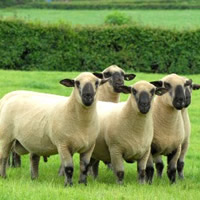
in Canada. They are large sheep, stocky, with excellent meat characteristics
and high-yielding carcass. They are extremely fast-growing and
serve both the light and heavy lamb market. The ewes are average
in prolificacy, long-lived, easy keepers and adapt to either
pasture or confinement management. Rams used as terminal sires pass on the Hampshire loin and
leg very consistently, but the lambs are large at birth and
large ewes should be used. They are very docile, easy to manage
and make an ideal small farm flock.
Body weight:
Rams: 115 - 150 Kg
Ewes: 80 - 115 Kg
Fleece: Medium coarse, semi-bright
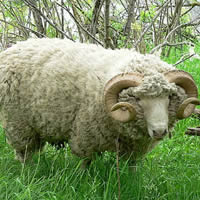 Horned Dorset
The exact history of the Horned Dorset is unclear. The breed was in Oregon in 1860, brought by the Hudson Bay Shipping Co., some were imported to the U.S. east coast from England for a livestock show in Chicago in 1885 and the breed was then imported into Canada sometime before 1900. Their ability to lamb out of season coupled with the ewes being excellent mothers, heavy milkers with a high percentage of multiple births are some of their most desireable traits which gives sheep producers the ability to have 3+ lamb crops in two years and get lambs to market weight early.
As a meat breed, they have exceptional muscle conformation and usually produce about a 50% live weight to carcass weight ratio. Horned Dorset sheep are on the Rare Breeds Canada list but through importation of rams from the U.S and semen imports from New Zealand and the U.K. good quality ram genetics are not difficult to obtain.
Body Weight
Rams: 100-125 kg
Ewes: 65-90 kilograms
Fleeces: 2.25-4 kg
Fiber diameter: 33.0-27.0 microns.
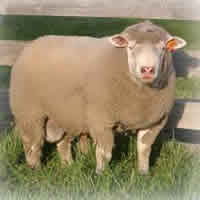 Ile de France
The Ile de France are a triple Purpose breed. They have excellent growth rate and carcass quality, strong maternal instincts and out-of-season breeding, and good wool quality. They are a polled, white sheep with depth, broad loin with good length, superior muscling, and a well-balanced body. It was developed in France in the 1830's and registered in 1892, making it one of the oldest breeds with a standards registry. The highest performance index embryos and semen, were imported to Canada in 1995. They are superior terminal sires, and produce vigorous, hardy, fast growing lambs, yielding carcasses which grade well and demonstrate superior muscling of the loin and leg. For cross-breeding with other breeds, the Ile de France add hardiness, longevity, feed conversion, out-of-season breeding ability, easy lambing, and excellent conformation to maternal ewes. These sheep are particularly successful when raised on only pasture and thus cost effective. The Ile de France produces a fine, heavy fleece that is very high in grease which results in low yields. The average fleece weight is 4 to 6 kilograms with a 7 to 8 cm staple length. The quality of the fleece is 56's to 60's.
Body Weight:
Rams 100 - 150 kg
Ewes 85 - 95 kg
 Jacob
Jacob
Handsome and Hardy the Jacob is ideal for the small flock owner or the large flock breeder. They are a small to medium breed allowing more sheep per acre. Colour is basically black & white or lilac spots at least 15% of each colour must be present. The fleeces from Jacobs are a delight for handspinners and connisseur of natural colour. Being a carrier of the polycerate gene they can produce 2,4.5 or 6 horns. The ewes are also horned.
They are easily handled, rarely need veterinarian care and show a great resistance to foot related problems and internal parasites. Ewes lamb easily and lambs are up and nursing quickly.
Body Weight:
Ewes: 80 to 140 pounds
Rams 150 to200 pounds
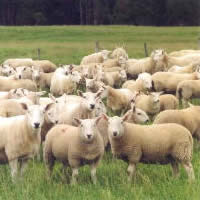 North Country Cheviot
The North Country Cheviot is a breed that has
been widely used for centuries in the North of England and Scotland.
They are an independent, outdoor sheep, strong-willed, vigorous
and very hardy in harsh climates and rough pasture. The ewes
show superior mothering instincts, deliver lambs easily and
feature the longest lactation period of any of the more popular
breeds. The lambs are very spry at birth. Although only average
in rate of gain, the carcass quality is very good, with high
red meat content and above average percentage yield. For all
of these reasons, North Country rams are often used in cross-breeding
to pass on the maternal strengths of the breed and to improve
carcass quality. Best suited to pasture systems where management is not intensive.
Body weight:
Rams: 100 - 125 Kg
Ewes: 55 - 80 Kg
Fleece: Bulky, low lustre
 *Olde English "Babydoll" Southdown
The "Babydoll" woolly teddy bear face will always give you a smile. Their short legs along with their small size allows them the ability to do well in small areas. They are ideal for suburban lot owners who want the tranquility of sheep as living lawn ornaments. Both ewes and rams are polled (have no horns) and are non-aggressive by nature. The ewes are very good mothers, often raising twins and triplets with ease. Because "Babydoll" Southdowns are a ancient breed are resistant to foot rot. In general, they are cared for like any other sheep which includes worming, hoof trimming, shearing, and vaccination.
Mature Size:
24" or under shorn, measured straight up the front leg to the top of the shoulder
Ewes under 18" are discouraged
Fleece: Fine texture, great density and of sufficient length of staple
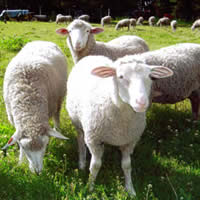 Polypay
The Polypay was developed at the Experimental
Station in Dubois, Idaho beginning in the late 1960s. Researchers
drew from four breeds: Finnsheep, Rambouillet, Targhee and Dorset,
to produce a prolific sheep that would lamb out of season and
produce a fast growing lamb and high-yielding carcass. The breed
was fixed in 1975 and has since spread to farms across the U.S.,
Canada and Mexico. Polypay lambs are good feeders and grow quickly and steadily
to 36 kg. They are docile, easily managed and thrive in pasture,
rotational grazing and confinement systems.
Body weight:
Rams: 90 - 125 Kg
Ewes: 60 - 90 Kg
Fleece: Fine, pronounced crimp
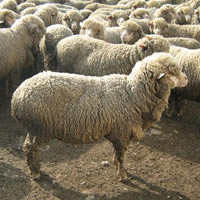 Rambouillet
Rambouillet are large sized sheep of good body length and muscle conformation. Rams are strongly masculine, Ewes are distinctly feminine. Their head is open faced free of wool around and under the eyes. Their ears are broad and relatively short and thick. They are polled or horned with sturdy necks free of wrinkles. Their shoulders are trim, smooth and well rounded. The chest is deep and full with moderate width between the forelegs. Their back is long, level and broad. Their loin is long and wide, thick with natural flesh throughout. Their legs are well set on their corners, straight, strong and thickly muscled with pasterns strong and upright with white hooves.
Body weight:
Rams 100-135 kg
Ewes 70-90 kg
Fleece:
Dense, long and uniform over whole body
No more than two grades drop on britch
Bright, clean, free from other fibres
Fine and white
 Romney
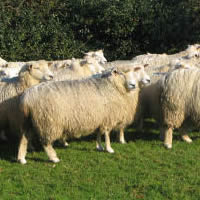
The Romney is a British longwool sheep that evolved
in the low, wet Romney Marsh district of Kent County, in Southeast
England during the 13th century. Effectively isolated from other
parts of the country for centuries by the Kent Forest, the Romney
developed on its own and adapted well to its damp and often
harsh environment. It was exported to New Zealand in 1853 where
it flourished and became the most popular breed in the country.
Because of its resistance to footrot and internal parasites,
the Romney has become popular in the wet coastal regions of
British Columbia. The lambs are large and lean and convert feed very well. They
are not a competitive sheep and when mixed with commercial breeds,
but docile and easily managed. Romney wool is in demand with
hand spinners who pay a premium for the fleece.
Body weight:
Rams: 90 - 100 Kg
Ewes: 65 - 80 Kg
Fleece: Medium coarse, lustrous white
 Scottish Black Face
All Blackfaces are horned, with black or black and white face and legs. The fleece should be free of black fibre and can vary from short, fine wool used for carpets and tweeds to strong coarse wool, which is sold mainly for the Italian mattress trade.
There are several distinct types within the breed. These have evolved over the years, influenced by climate, environment and grazing quality. This gives the breed the advantage of being able to produce species to suit every climatic condition.
 Shetland
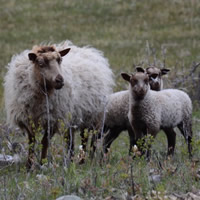
Shetlands are a small sized sheep, alert and nimble, giving a smart active appearance. Rams are generally with horns, ewes are generally polled. They have wool on their forehead and poll tapering into
the neck, likewise wool on cheeks. The variety of colour and fineness
of the wool is a distinguishable feature of the breed. Wool
on the tail tapers off from the base leaving the lower end almost
bare, except for short stubby hairs. This feature readily permits
the purity of the breed to be gauged.
Body weight:
Rams: 40-75 kg
Ewes 30-60 kg
Fleece:
Extra fine and soft texture, longish, wavy and well closed.
Length 5 to 10 centimetres, which ideally should have 9-10 crimps
per 2.5 centimetres.
 Southdown
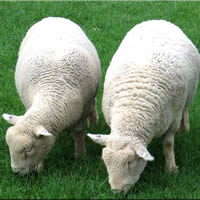
The Southdown was developed in Sussex, England
during the late 1700s and early 1800s and exported to the U.S.
shortly after. In this century it became known as the "Aberdeen
Angus" of the Canadian sheep industry because of its ability
to flesh out a small carcass, however, the breed dropped drastically
in numbers in the 1960s because of its too small stature and
difficulty with lambing. Breeding improvements have restored size to the Southdown and
while preserving its feed conversion efficiency and the breed
has come back in favour. It is a medium-sized sheep that excels
in producing meaty carcasses for the medium to light lamb market.
The Southdown is very docile, adapts well to confinement operations
and can easily be finished on pasture. Southdown rams are widely
used as terminal sires to put finish on many other breeds but
the ewes are usually bred pure. Because of its size and gentle
nature, the Southdown make an excellent starter flock or 4-H
project for children.
Body weight:
Rams: 85 - 105 Kg
Ewes: 60 - 80 Kg
Fleece: Dense, fine
 *St. Croix
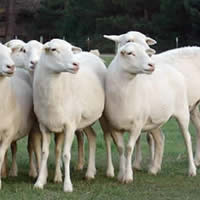
St. Croix are prolific, often with two lamb crops per year with the total flock
averaging 230% annual lamb crop raised to market. Yearlings
average 1.5 lambs born per birth with later lambings averaging
over 2.0 lambs. They are good on rough forage utilizing coarse fodder. In addition they are adapted to hot climates. They have inherent resistance to internal
parasites. Gentle and easy to handle - both sexes are hornless. St. Croix are haired sheep
and naturally shed their winter coat in spring. Lambs finish out without excessive
fat and the carcass conformation is similar to a Ramboulillet
with the exception that the St. Croix has a higher slaughter
yield. Very few birthing problems. This includes young females who generally
lamb their first time at one year of age.
Body weight:
Rams: up to 90 Kg
Ewes: up to 75 Kg
 Suffolk
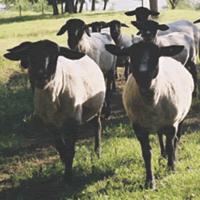
The Suffolk was developed in the early 1800s
in the southeastern area of England by crossing Southdown and
Norfolk Horned sheep. It came to Canada in 1888 and interest
in the breed rose rapidly after 1920. It is now the dominant
breed in Canada. Because the Suffolk lambs are usually twins, exceed all others
in rate of gain, respond well to confinement and command higher
prices, they offer the best economic returns in the industry
and continue to dominate the heavy lamb market in Canada. The
rams are widely used as terminal sires on rangelands because
of their ability to pass on valuable traits in meat production:
i.e. rate of gain, carcass quality and high red meat content.
However, the Suffolk is a heavy feeder and those breeders enjoying
success with them have kept them at a moderate size, resisting
recent trends by some breeders to make them bigger. The moderate sized Suffolk is an efficient converter of feed,
somewhat shorter-lived than white-faced breeds and performs
best on small farms and acreages under controlled management.
Body weight:
Rams: 115 - 150 Kg
Ewes: 100 - 115 Kg
Fleece: Dense, fine with no black fibres, fine crimp
 Texel
Texel
The Texel originated on the Isle of Texel off the coast of The Netherlands early in the nineteenth century. The characteristics of the breed were established early with the emphasis on a sheep that would produce heavily muscled lambs of superior eating quality. The most outstanding feature of the Texel breed is its muscle development and leanness.
The Texel has become the dominant terminal-sire breed in Europe. It is currently nearly equal to the Suffolk in market-share in the United Kingdom. The Texel breed today is a white-faced breed with no wool on the head or legs. The breed is characterized by a distinctive short, wide face with a black nose and widely placed, short ears with a nearly horizontal carriage. These sheep also have black hooves.
Mature body weights:
Rams 80-95 kg.
Ewes 70 80 kg.
Fleece: medium grade (46's-56's) .
White fleece is fine, closely set and contains no superfluous lanolin with no black fibers
Mature animals shear fleece weights of 3.5-5.5 kg

